
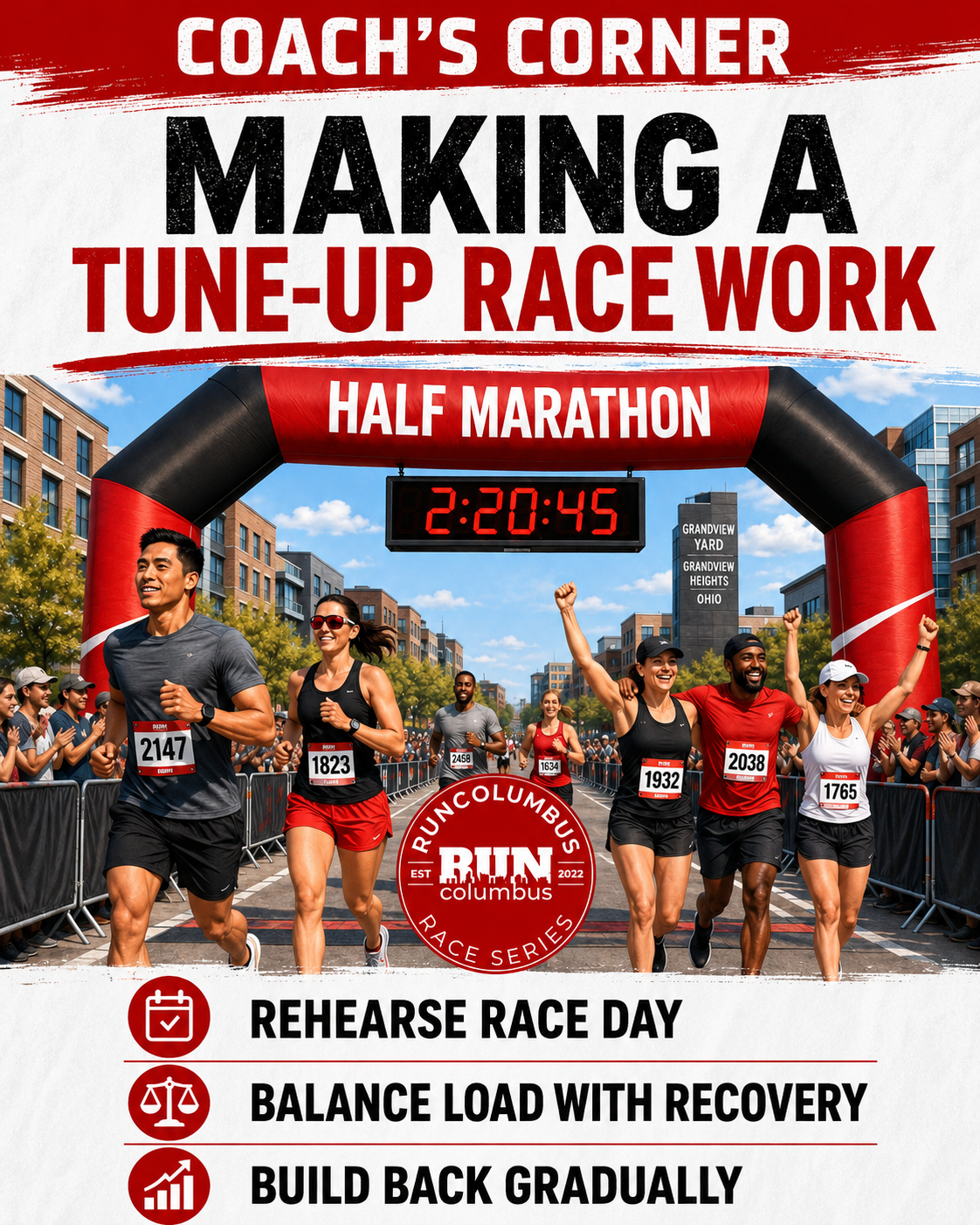
A secondary race can provide valuable feedback as you prepare for your primary goal race. A tune-up race can provide an honest snapshot of your current fitness, helping you establish realistic pacing and performance goals for your primary event. It provides a realistic rehearsal for navigating crowds, controlling your early pace, managing nerves, and following your fueling and hydration plan in an actual race environment. It is also an opportunity to test your shoes, socks, clothing, and anti-chafing strategy under conditions that may expose problems you did not notice during regular training. Before race week, decide whether the secondary race will be a hard benchmark effort or a controlled training run, because that purpose should determine how you approach the days before and after it.
A race should be folded into your training load, not simply added on top of it. Combining your regular mileage, scheduled effort days, and a hard race can lead to excessive fatigue and increase the risk of injury. Arriving at the starting line tired may also produce a disappointing result that falsely suggests your training is not working. Consider reducing your mileage and the number of hard workouts during race week to balance your training load, recovery, and planned race effort. This mid-cycle mini-taper does not mean shutting down your training. It simply creates enough freshness to perform well and protects the work still ahead. Backing off can feel uncomfortable when you have been steadily building volume, but a brief reduction will not erase your fitness gains. It gives your body time to absorb the training you have already completed.
The race distance may not match the long-run mileage scheduled for that weekend. If a half marathon falls on a day calling for 16 miles, you might complete an easy mile before the start and, if you still feel good, one or two relaxed miles afterward. However, completing the exact mileage is less important than recovering safely from the race. The later the race falls in your training cycle, the more carefully you should examine and adjust both the preceding and following weeks. A hard benchmark effort may require removing effort sessions the next week if fatigue or soreness lingers. It is also unwise to follow a hard half marathon by jumping directly into a 20-mile run, particularly in challenging weather. Shift the schedule to create a gradual return to training that supports confidence, recovery, and preparation for the longer miles ahead. A tune-up race can sharpen your goals and help complete a successful training cycle, but sometimes that requires controlling your inner runner or walker and making the choice that benefits the larger goal.
Dr. Chris Taylor, PhD, RDN, LD, FAND, RRCA Level I Coach is a running coach, registered dietitian, and nutrition researcher at The Ohio State University. He serves as the lead coach for the Columbus Westside Running Club, supporting runners of all abilities through evidence-based training and practical nutrition guidance. An active participant in the RUNColumbus Race Series, Chris brings a unique blend of academic expertise, coaching insight, and community engagement to every mile.