
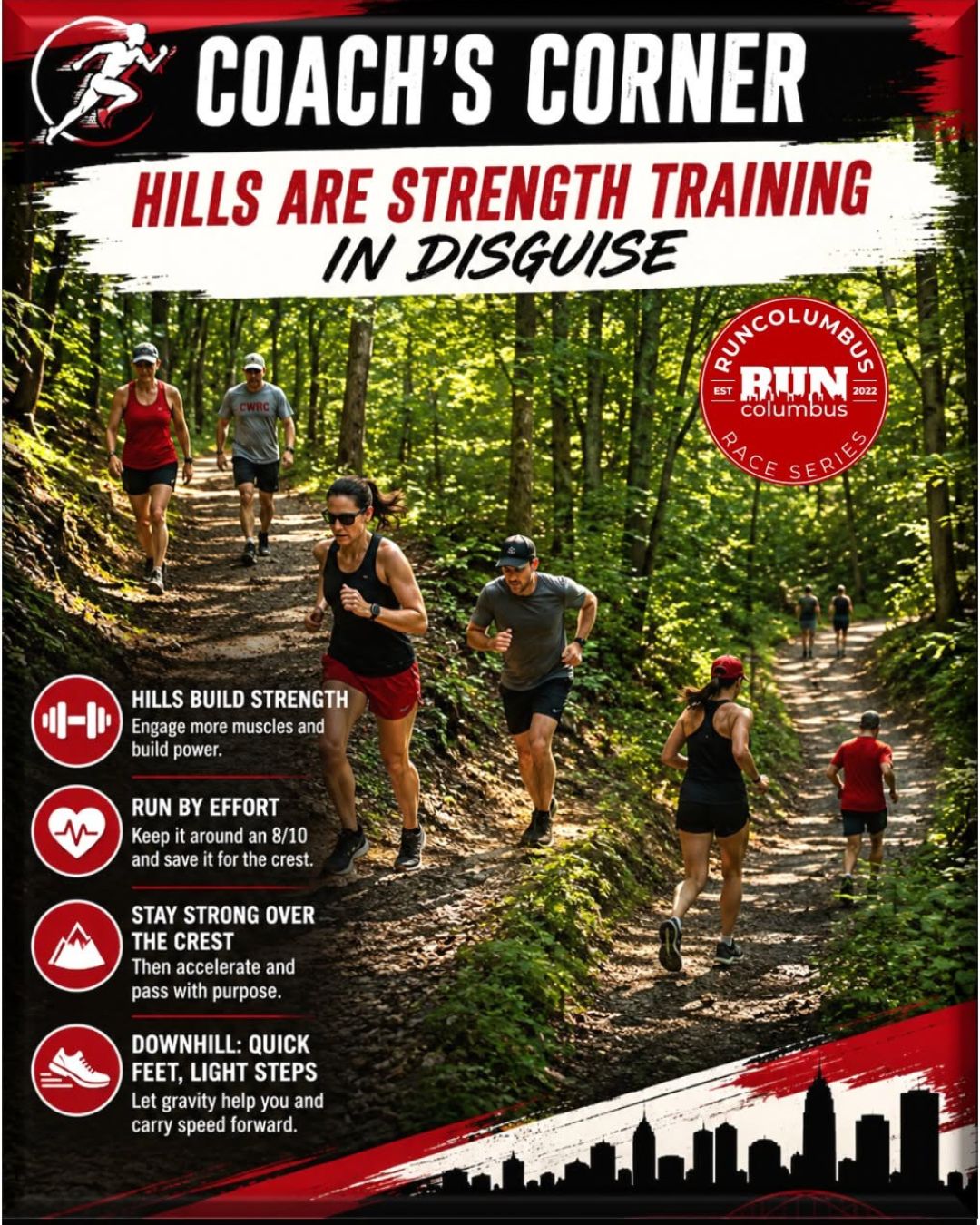
When runners and walkers think about strength training, they often picture barbells, dumbbells, or gym machines. Ironically, many of us go out of our way to avoid hills when planning our routes, even though they are among the most effective strength workouts available. Every climb forces your body to work against gravity, recruiting and engaging your glutes, hamstrings, quadriceps, and calves in a way that closely mimics sport-specific strength training. Hills also activate more muscle fibers than running on flat ground, helping improve power and efficiency without the same pounding as all-out speed work on a track. Because your stride naturally shortens and your foot lands closer to your center of mass, there is typically less impact on the knees, shins, and lower back while still challenging your cardiovascular system. Over time, hill training improves stroke volume, allowing your heart to pump more blood with each beat. It also helps build the mental toughness needed to keep moving when races become difficult, or when they plop in that sneaky hill right before the finish line [it is in the Race Director’s Manual – we checked].
Success on hills comes from running with purpose rather than chasing pace. Focus on keeping your chest open, shoulders relaxed, and your eyes looking 10 to 20 feet ahead, not at your feet. Maintain a slight forward lean from your ankles, not by bending at the waist, driving your knees up and forward, while pumping your arms from hip to chest to generate momentum. Your arms act as levers for your legs, so if you swing your arms, your legs will follow suit. The goal is not to sprint uphill. Instead, think in terms of effort. An intensity around 8 out of 10 is challenging enough to develop strength and fitness while allowing you to maintain good form. One of the most valuable racing skills is resisting the temptation to empty the tank before reaching the top. Stay controlled on the climb, then continue over the crest before gradually accelerating. Many runners attack the hill too aggressively, only to fade immediately afterward. Those who stay patient often pass competitors once the hill levels off.
The downhill deserves just as much attention as the climb and is worth practicing. Rather than fighting gravity, learn to work with it. One of the biggest mistakes is leaning backward and reaching your foot too far in front of your body. This creates a braking effect with every step, increasing impact through the knees and hips while wasting valuable momentum. Leaning too far forward creates the opposite problem, making it feel as though you’re falling downhill and increasing the risk of a head-over-heels fall. Instead, stay tall with your hips squarely underneath you and picture the Road Runner’s legs spinning rapidly beneath your body. Quick cadence, not long strides, is the key. Light, fast foot strikes help you stay in control, reduce eccentric muscle damage that often causes soreness after hilly races, and carry speed naturally into the flat sections ahead. Mastering both the climb and the descent transforms hills from something to fear into one of the most effective workouts you can include in your training.
Dr. Chris Taylor, PhD, RDN, LD, FAND, RRCA Level I Coach is a running coach, registered dietitian, and nutrition researcher at The Ohio State University. He serves as the lead coach for the Columbus Westside Running Club, supporting runners of all abilities through evidence-based training and practical nutrition guidance. An active participant in the RUNColumbus Race Series, Chris brings a unique blend of academic expertise, coaching insight, and community engagement to every mile.